What’s a “wicked problem?” How to make a profit on the next film in the Elphaba saga? The way a Bostonian would describe the closure of their local Dunkin’ Donuts?
According to Dr. Peter Rabinowitz, it’s a term for challenges so complex they don’t have a simple solution—think climate change, poverty and homelessness. Rabinowitz, a professor in the UW Department of Environmental & Occupational Health Sciences (DEOHS), recently taught a course that challenged graduate students in the department to devise solutions for seven of these thorny problems in public health.
They included issues local to the Pacific Northwest, like improving waste management solutions for dairy farms, reducing the risk of wildfires, preventing overfishing, and reducing harmful algal blooms. But they also represented global concerns: saving coral reefs, preventing dengue fever outbreaks in Peru, and reducing the burden of antimicrobial resistance in the Philippines.
“Not only are these wicked problems, but they require interdisciplinary and interagency work,” said Elizabeth Blake, a PhD student in DEOHS who took the class. “They could take years to fix—but we thought about the logistics of how you would do it.”
Solving interdisciplinary problems
The course, called Foundations of Environmental and Occupational Health, is the introductory class required for new graduate students in DEOHS. This year, Rabinowitz implemented an approach to interdisciplinary problem solving developed by the University of Leuven in Belgium.
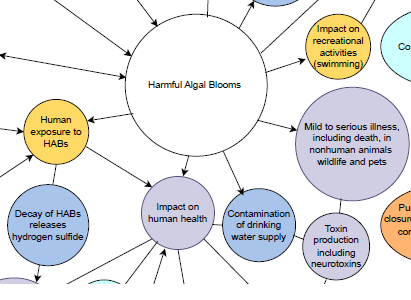
Each small group of students selected a problem and developed a theory of change for it, then created a “concept map” of the system that they were planning to change, which defined the factors contributing to the problem and the regulations in place so far. Building on this framework, the groups identified stakeholders that could either facilitate or stand in the way of change, as well as key leverage points in the system that would be most effective.
“The goal of the experience was to demonstrate that change is possible, even for complex systems, and to develop skills in interdisciplinary problem solving that will be useful for students in their careers,” Rabinowitz said.
Reducing dairy farm waste in Washington state
Blake and her group focused on managing waste for dairy farms in Washington state. Lagoons of manure increase greenhouse gas emissions and contribute to climate change, but there are not yet policies to limit these emissions or incentives for farmers to control them on their own.
Blake and her team saw a solution in the use of anaerobic digesters, which process manure to collect methane and solids that can be converted to biogas and fertilizer, respectively, and then sold. Currently, 9 dairy farms in the state use them, as well as 33 other nonfarm facilities—for example, restaurants that use them to process food waste. But the digesters cost millions of dollars, so many dairy farms can’t afford them.
Instead of tailoring their recommendations to politicians or government agencies, Blake’s team decided to focus on farmers themselves. They recommended a “hub-and-spokes” model where many farms—or other local businesses—use a central waste digestion facility, sharing the costs of the facility and the profits of the products.
“This is a way to build community ties and make it feasible for everyone involved to reap the benefits,” Blake said.
Rabinowitz, who partners with dairy farmers in his research, told farmers at an agricultural convention about Blake’s group’s project, and brought the group back informational pamphlets and samples of biochar, a soil amendment that can be produced from manure.
“I thought, Wow, grad school is different,” Blake said. “Grad school is very real. We just wrote a paper about this, and now the people we wrote the paper about are hearing about it. It was definitely more than I thought would come out of this project.”

Controlling harmful algal blooms in Puget Sound
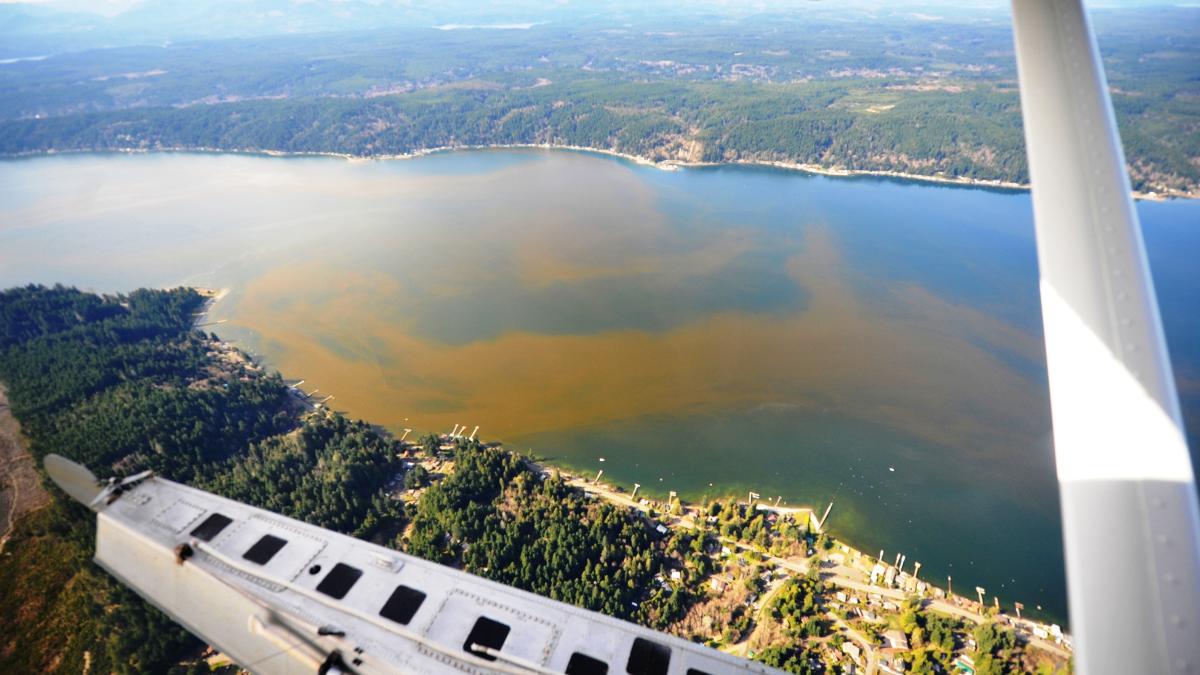
Master’s student Anjali Choudhury’s group focused on the wicked problem of harmful algal blooms in Puget Sound. These blooms deplete oxygen, causing fish kills, and their toxins can also poison people and pets.
The blooms are stimulated by excess nutrients, including nitrogen and phosphorus, that run off into the sound, primarily from wastewater treatment plants. They are predicted to worsen in the coming decades because of our warming climate and the growing population of Puget Sound—it’s expected to double by 2070.
“Wicked problems are complex and don’t have an easy solution,” Choudhury said. “All of the problems within them are a symptom of another problem, so it’s difficult to figure out where to target the solution or intervention.”
To learn more, Choudhury’s group reached out to a staff member at the Washington State Department of Ecology, and learned that the agency had a plan to limit nitrogen inputs to the Sound from wastewater treatment plants, but it hadn’t been implemented because of legal challenges.
The team recommended three solutions: first, amending Washington state law so that the agency could ask plants to opt into a permitting system to report the amount of nitrogen they released into the Sound. Second, offering an incentive for plants to opt in, such as giving companies more time to comply with eventual regulations if they opted into permitting. Finally, they suggested that the agency create an information sheet for treatment plants explaining the ecological impacts of nitrogen release into the Sound, the importance of reporting nitrogen loads, and the incentives to do so.
An inspiring learning environment
Both Blake and Choudhury are excited to apply what they’ve learned from the course in their eventual careers in public health, whether in academia, government agencies, or international development organizations.
The course also helped them get to know fellow students in their cohort and engage with their diverse perspectives and backgrounds. Some students had extensive experience working in government and policymaking, allowing teams to have a much clearer vision of real-world solutions.
The students also appreciated Rabinowitz’s engaging and supportive teaching style.
“He really wanted to see us succeed,” Choudhury said. “On the first day of class, he already knew all of our names. It made me feel very welcomed.”