
Here you can:
Investigate the
links between air
pollution and
dementia.
Harness your passion for improving public health.
At DEOHS, you can:

Study how the air we breathe affects the aging brain, cognitive decline and dementia risk.
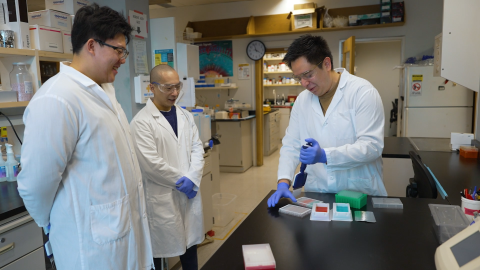
Investigate how environmental chemicals influence autism risk.

Explore environmental stressors that impact children's asthma in farming communities.
Why study Environmental Toxicology?
Environmental toxicologists study how chemicals affect human health and the environment, applying principles of biology, chemistry and epidemiology. Toxicologists predict where chemicals will end up in the environment and in our bodies, analyze the toxic impact of chemicals and monitor exposure limits to keep us and our environment healthy.
As a student focusing on Environmental Toxicology, you will:
- Take common core courses introducing foundational concepts and skills, including: risk assessment, management and communication; assessment and management of exposures to environmental hazards; core principles of toxicology; and how to use a One Health approach to address complex challenges.
- Learn how a wide range of toxicants (such as pesticides, metals, solvents, air pollutants, persistent organic pollutants and radiation) affect human health and gain skills in identifying, characterizing and controlling environmental hazards.
- Complete a culminating experience (thesis, project or dissertation) showcasing your ability to integrate the skills you have learned to address an environmental or occupational health problem.

“The combination of community participatory research and statistical analysis related to lead in eyeliner is unique. It’s a problem-solving success story that wouldn’t be possible without community involvement and community wisdom.”
Aesha Mokashi, MS, 2024
Read moreStudent research
Ryan Babadi
Phthalate exposure, respiratory outcomes and biomarkers of oxidative stress in children with asthma
PhD in Environmental Toxicology, 2020
Faculty: Catherine Karr
Rachel Shaffer
Fine particulate matter, neuropathologies and dementia
PhD in Environmental Toxicology, 2020
Faculty: Lianne Sheppard
Jongpyo Joe Lim
Acute and persistent effects from environmental toxicant exposure on the gut-liver axis
MS Thesis in Environmental Toxicology, 2020
Faculty: Yue Cui
Our faculty and research

“The totality of exposures we get throughout life, and how they interact with our genetics, really define our health.”
Judit Marsillach
DEOHS Assistant Professor
Research spotlight

Uncovering workplace hazards as a medical detective
Dr. Robert Harrison delivers the 2026 Breysse Lecture on October 22

A fearless public health advocate retires
DEOHS Professor Lianne Sheppard retires after 33 years tracking how small exposures add up to big health risks

Experts warn of a weed killer’s health harms
At Seattle Glyphosate Symposium, dozens of scientists urge regulators to protect public health from the widespread pesticide
Career pathways
Our Environmental Toxicology graduates work in the public and private sectors and in academia. Recent DEOHS graduates work as:
- Senior Toxicologist at Boeing.
- Public Health Toxicologist at the Oregon Health Authority.
- Postdoctoral Fellow at the National Oceanic and Atmospheric Administration.

"I graduated with a core toxicology skill set, which I use daily to help clients and guide them through the regulatory process."
Tyler Nicholas, PhD, 2019
Read more