In 2023, three people died after drinking milkshakes from a restaurant in Tacoma, Washington. The cause of the outbreak was traced to listeria, a foodborne bacteria, that had grown in the restaurant’s milkshake machine.

Ella Collins
BS, Environmental Public Health
Hometown
Puyallup, WA
Internship with
Food safety in Emily Hovis lab
Ella Collins, an environmental public health major at UW who grew up in nearby Puyallup, remembers hearing about the incident at the time. When Associate Teaching Professor Emily Hovis, the instructor of her class on environmental health policy, mentioned a project designed to prevent similar outbreaks, Collins was eager to be part of it.
So Collins spent last summer in “food safety land,” as she put it, interning with Hovis’s lab in the UW Department of Environmental & Occupational Health Sciences (DEOHS).
She joined two projects: one focused on providing clearer guidelines for maintaining frozen dessert machines like those in Tacoma, and another on ensuring food safety in local micropantries and community fridges.
“This was my first time doing any type of research or internship,” she said. “It’s been great to learn what the process is like, and I’m very interested in doing more research in the future.”
Soft-serve safety
“Listeria is really serious,” Collins explained. “It can grow at refrigeration temperatures. The bad outbreak in Tacoma a few years ago was linked to improper cleaning of the machines.”
To prevent future outbreaks, Collins worked with Hovis and DEOHS grad student Gracie Hively to understand where gaps in regulations may let microbes slip through. They examined relevant food codes provided by the U.S. Food and Drug Administration and Washington state, as well as frozen dessert machine manuals, and found that these sources often have unclear or conflicting guidance.
To address the problem, they surveyed food inspectors across Washington state to assess their understanding and practices related to frozen dessert machines. After hearing that clearer guidance was needed, they created a toolkit that both operators and inspectors can use to ensure effective, consistent disinfection.
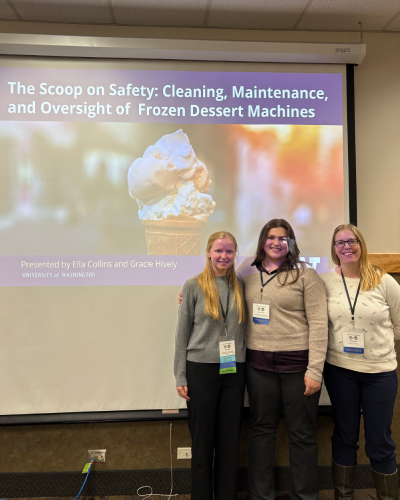
In October, Collins and Hively presented their results at the joint conference of the Washington State Environmental Health Association and the Washington State Public Health Association, as well as during a food safety workshop for inspectors in Washington state.
“It’s been really cool to draft these educational materials,” Collins said. “I feel like they are actually going to be used by people and be helpful.”
Protecting little free pantries
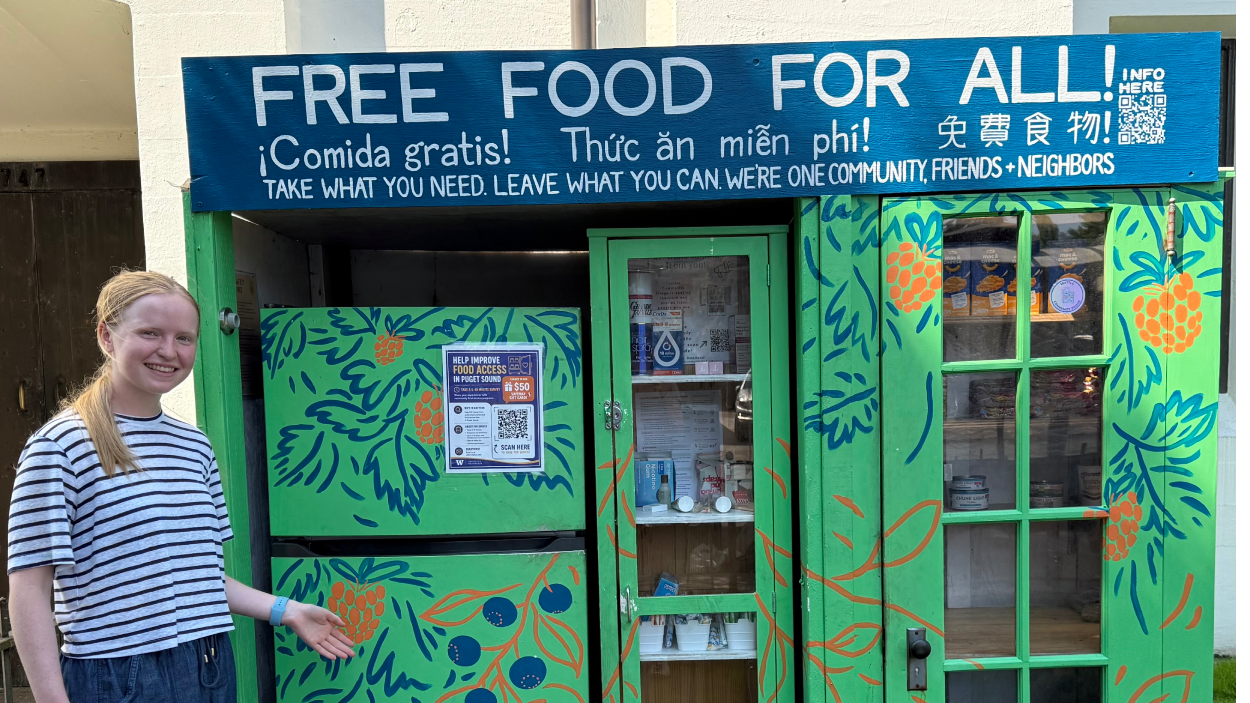
In another project in Hovis’s lab, Collins visited several micropantries and community fridges around Seattle to explore efforts to keep this mutual-aid approach to food sharing safe for all.
“They’re like little free libraries, but for food,” she said. “I saw so many people using them everywhere I went.”
She conducted safety assessments at several of these sites, including assessing contents and temperature, along with DEOHS grad student Anna Kirchoff.
But the best part for Collins was connecting with the many people coming by these pantries to drop off or pick up food. At a fridge outside St. Joseph Parish in Seattle’s Capitol Hill neighborhood, she met a couple who solved the team’s concern about the safety of a carton of “mystery eggs.”
The couple told them that they dropped off a carton of hard-boiled eggs each morning on their way to Mass, and the team shared their suggestions about best practices for food safety. The next time the team visited the site, the day’s batch of eggs was labeled with its contents and a date, as they had suggested.
Collins is inspired to be part of a larger UW-led pilot project focused on outfitting some of these sites with smart sensors, which is funded by the U.S. National Science Foundation and includes several UW departments and private, nonprofit and government agency partners. The team plans to create a digital dashboard for micropantries so that users can check data on temperature and weight, which are reported by the remote sensors.
A big enough umbrella
Collins entered her junior year this fall after spending a month studying sustainable business in Denmark, as part of her double major in environmental studies. She is already thinking about pursuing a graduate degree in environmental health, and perhaps even continuing her work in food safety.
This fall, Collins was awarded a Cynd M. Treser Memorial Scholarship, which recognizes undergraduate students majoring in environmental health who plan to work in the field after graduation.
“What’s cool about environmental health is that there’s so much under the umbrella,” she said. “I can go in so many different directions.”