Media contact:
Alden Woods: acwoods@uw.edu
Lisa Van Cise: vancisel@uw.edu or ehcomms@uw.edu
March 27, 2026
(SEATTLE) - International experts who gathered March 25 and 26 at the Seattle Glyphosate Symposium are calling on regulators around the world, including the U.S. Environmental Protection Agency (EPA) and European Food Safety Agency (EFSA), to address glyphosate’s well-documented harms to human health and its links to cancer and other chronic diseases.
The call for stronger, science-based regulatory action came from leading scientists, legal experts and communicators who met at the University of Washington to explore the latest research on the public health risks of glyphosate, the world’s most widely used herbicide and the active ingredient in popular weed killers like Roundup.
“The evidence that glyphosate and glyphosate-based herbicides (GBHs) harm human health at levels of current use is now so strong that no additional delays in regulation of glyphosate can be justified,” said Kurt Straif, a research professor at Boston College and expert in global cancer control.
The specialists came together to update the 2016 paper “Concerns over use of glyphosate-based herbicides and risks associated with exposures: A consensus statement.” The full findings of the group, which included leading specialists in epidemiology, toxicology, cancer and risk assessment, will be detailed in a peer-reviewed paper expected to be published later this year.
Symposium attendees drafted an expert statement and presented substantial new evidence and research published in the last decade that documents the health harms linked to glyphosate exposure, including neurological, kidney and liver diseases and those of the reproductive, endocrine and metabolic systems.
“It is critical that regulatory agencies apply the compelling evidence that glyphosate can cause non-Hodgkin lymphoma and possibly other cancers. This evidence should be acted upon immediately,” said Christopher Portier, an expert in the science supporting regulatory decisions and adjunct professor at Emory University.
A renewed call for glyphosate regulation
Participants concluded glyphosate and GBHs should be better regulated in order to protect public health, substantially reduce glyphosate residues in the food supply and empower people across the globe to better understand and reduce their exposures.
“Because U.S. pesticide oversight is routinely failing to meet an acceptable scientific standard, Americans are suffering needlessly from terrible and sometimes fatal diseases. This will never change until lawmakers and elected officials force the EPA’s pesticide office to free itself from the stranglehold of industry influence and start fully protecting public health,” said Nathan Donley, environmental health science director at the Center for Biological Diversity.
Protecting health for all and ensuring health-protective policies
“While we need better regulations to reduce glyphosate exposures, we also have to address the significant barriers and delays that have resulted in delays in reducing the health harms from glyphosate. This includes documented interference by the companies that manufacture glyphosate, government agencies influenced by commercial interests, and ghostwritten scientific papers that have distorted the public’s understanding of the true health harms of glyphosate,” said Tracey Woodruff, professor at Stanford University. “To meaningfully address glyphosate and other pesticide exposures, reforms are needed to remove financial conflicts of interest from the scientific process and peer review, and public funding for research must be increased,” said Woodruff.
Participants called on regulators to improve the processes used to evaluate pesticides to account for the unique vulnerability of fetuses, infants and children to pesticides; account for the full range of response of people to pesticide exposures; account for exposures to many pesticides and chemicals at the same time; and account for the harm to highly impacted communities such as farmworkers.
The group’s expert statement also asks policymakers to focus on reducing pesticide use and exposures and funding the replacement of harmful pesticides with more sustainable and healthy agricultural practices while ensuring that any reduction in glyphosate use does not result in regrettable increases in use of other harmful pesticides.
“With the upcoming glyphosate reregistration review, EPA needs to recognize and address the adverse public health impact of this ubiquitous toxic exposure,” said Lianne Sheppard, symposium organizer and Rohm & Haas endowed professor in public health sciences at the UW. “We need to reduce population exposures to glyphosate and empower individuals to understand and reduce their own exposure to this and other pesticides.” Sheppard was a member of the EPA panel that reviewed the agency’s glyphosate human health risk assessment in 2016.

About the Seattle Glyphosate Symposium
Nearly 70 experts contributed research and input through their attendance, presentations and poster sessions at the two-day Seattle Glyphosate Symposium at the UW.
A list of meeting presenters and their expertise is on the UW Department of Environmental & Occupational Health Sciences website: deohs.uw.edu/sgs.
###
Media Kit
https://drive.google.com/drive/folders/1EmlvD7mN7Ng4K6n7rhcqWG-oEyMQVZ6h
Media kit image name and descriptions:
Photo credit: Elizar Mercado
Chris talking at SGS: Christopher Portier, adjunct professor at Emory University, addresses the Seattle Glyphosate Symposium attendees March 25, 2026.
Kurt talking at SGS: Kurt Straif, a research professor at Boston College, addresses the Seattle Glyphosate Symposium attendees March 25, 2026.
Lianne and Chris: Lianne Sheppard, symposium organizer and Rohm & Haas endowed professor in public health sciences at the UW, and Christopher Portier, adjunct professor at Emory University, talk with participants on the UW campus during the Seattle Glyphosate Symposium.
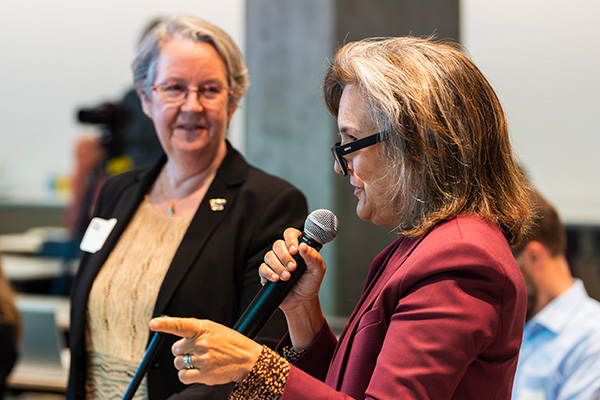
Tracey talking to Cynnie: Tracey Woodruff (right), professor at Stanford University, talks with Cynthia Curl, associate professor at Boise State University, at the Seattle Glyphosate Symposium on the UW campus.
Tracey with Lianne: Tracey Woodruff (right), professor at Stanford University, and Lianne Sheppard, symposium organizer and Rohm & Haas endowed professor in public health sciences at the UW, discuss the latest research on the impact of glyphosate to human health at the Seattle Glyphosate Symposium.