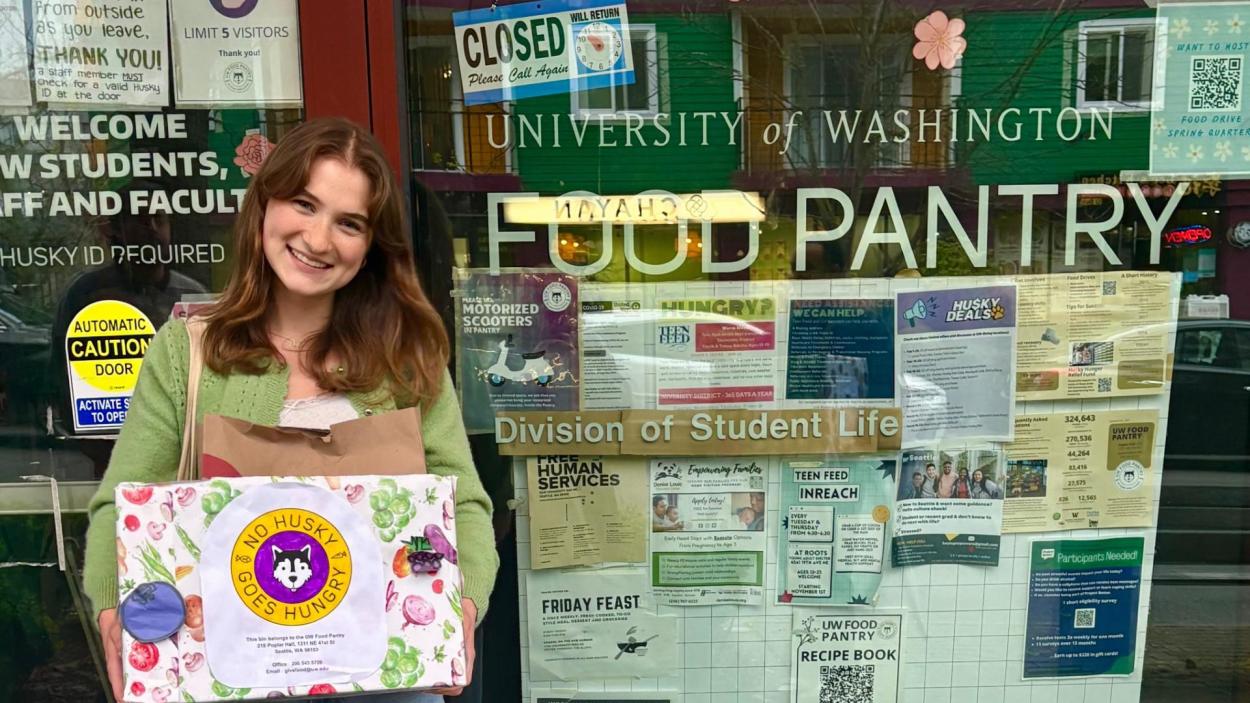
About 750 people visit the UW Food Pantry each week. For several years now, environmental public health major Angelina Durbin has helped them stay nourished by recovering leftover prepackaged meals from dining halls and markets on campus as the pantry’s food recovery coordinator.
Angelina Durbin
BS, Environmental Public Health
Hometown
Sammamish, WA
Future plans
Working on sustainable food systems with community organizations; graduate studies in environmental health and policy
"When you’re making policies related to hunger relief, you need to have experience informed by people experiencing food insecurity."
-Angelina Durbin
Last year, with demand nearly the highest it’s ever been, Durbin started expanding her gleaning efforts to include off-campus food suppliers. But she also saw an opportunity to feed students and reduce food waste by taking advantage of leftovers from catered events on campus.
“It drove me crazy to go to events and see all these trays of perfectly untouched sandwiches getting dumped into the compost, or even the landfill sometimes,” she said.
So she and a fellow UW student have worked to launch a messaging system called FreeFoodAlert on the UW campus. Started at Johns Hopkins, the app allows students to opt in to alerts that tell them when a catered event on campus ends, so they can glean the leftovers.
“We’re providing more opportunities for people to access food and have a hot meal that’s available on campus,” Durbin said.
In recognition of her efforts to boost food access on campus, as well as her academic explorations ranging from sustainable food systems to climate and health, Angelina Durbin was named to the 2026 Husky 100, a group of students honored for making the most of their time at the UW.
“Angelina stands out because she has intentionally shaped the Husky Experience for so many. Angelina builds systems—whether improving food recovery logistics at the UW Food Pantry, co-founding the UW chapter of FreeFoodAlert, or leading experiential learning within Project Indoor Farm,” said DEOHS Professor Jennifer Otten. “Her work materially improves UW’s food security landscape and models what student-driven systems change can look like.”
Finding environmental public health
Durbin started her Husky experience as an environmental engineering major, but soon felt she wanted more of a human element in her studies. Then she learned about the environmental public health major from undergrad Tejasvini Vijay, now her close friend and fellow officer in the Student Environmental Health Association.

“I was interested in a lot of solutions that are oriented more toward people and public health, and not as technical,” Durbin said. Soon afterwards, she met with DEOHS adviser Janet Hang and switched her major to environmental public health.
“The community that the major provides is so supportive, and the faculty and classes have provided me with an incredible foundation for everything else I’ve done,” she said.
Since then, Durbin has also minored in nutrition and delved deeper into food security, agriculture, and the health impacts of climate change. She explored sustainable food systems in Italy through a study abroad program led by Otten. And she wrote stories on climate work beyond the lab and making food systems resilient to climate change as a communications intern with UW EarthLab and the UW Center for Health and the Global Environment (CHanGE).
She’s currently helping coordinate a CHanGE project supported by the Global Fund on how climate risks impact HIV, tuberculosis and malaria in Mozambique, Kenya, Zambia and Zimbabwe. She also contributed her food donation expertise to a policy committee DEOHS Professor Emily Hovis convened for the Conference for Food Protection.
Her DEOHS studies on food safety came in handy in her FreeFoodAlert project: she made sure the program adheres to time and temperature control guidelines provided by UW Environmental Health & Safety. She recently received a Mary Gates Leadership Scholarship to support her work on the project.
Farming indoors
Durbin is the co-president of Project Indoor Farm, a student-led hydroponics organization on campus. Although she began working with the group because of her interest in engineering, she has led community engagement efforts there for several years now, including class tours and social media outreach.
“Being able to engage people in the food system who aren’t majoring in food systems or environmental fields is really cool,” she said. The club’s automation team includes students majoring in engineering and computer science who love growing their own food and coming together for potlucks.
Communications and community
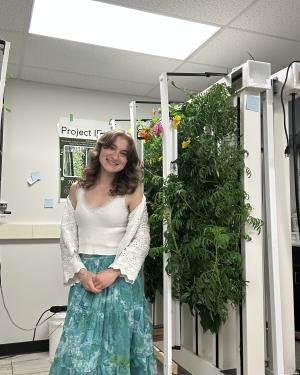
Whether it’s building community partnerships to glean more food for students, coordinating with campus partners to organize FreeFoodAlert, or sharing her expertise with fellow students, communication is central to Durbin’s growth as a collaborative leader.
At the Food Pantry, she started a volunteer program for food recovery leadership: each quarter she mentors five volunteers who take on their own projects, including pursuing partnerships with farmer’s markets and designing infographics and social media posts.
She is also a member of the UW Food Systems Leadership Coalition, which connects many campus organizations focused on food policy and food insecurity.
After she graduates this spring, Durbin hopes to continue working with community organizations and advocating for more sustainable food systems. Eventually, she’d like to pursue graduate studies in environmental health, food systems, climate adaptation and policy.
But the bonds she has made through her wide-ranging pursuits at the UW will remain. “My community at the pantry has inspired me to keep continuing this work on food insecurity and food waste,” she said. “They’ve truly been my home.”