Strengthening sustainable, healthy food systems requires countless people working together across professions, disciplines and geographies. Teaching the next generation how to do this work requires the same spirit of collaboration.
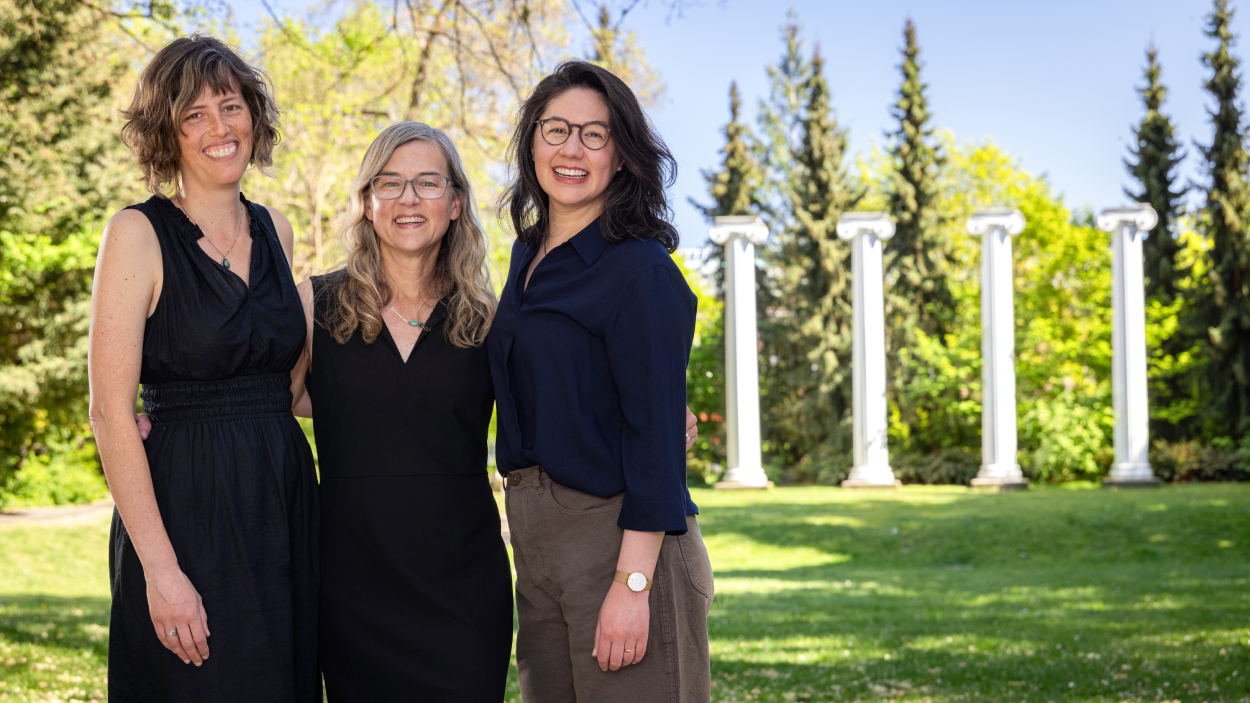
That’s the perspective of UW School of Public Health faculty Jennifer Otten, Marie Spiker and Sarah Collier, who have approached teaching the subject of food systems as a collaborative effort. Through team mentorship and classes, they can be seen working across scientific disciplines and encouraging students to bring their unique ideas to addressing one of our most challenging societal questions: how do we cultivate sustainable, resilient food systems that advance population health?
Their unique approach has earned them recognition from this year’s UW Excellence Awards. For their collaborative work in teaching and mentorship, they received the 2026 Distinguished Teaching Award for team instruction.
“The idea of studying food systems as a solo researcher is sort of counterintuitive, because the interdisciplinary nature of the field requires team science,” Spiker said. “Our team teaching and team mentorship is a natural extension of that.”
Tackling the big questions about food
The three believe it’s critical to think across disciplines to tackle the big questions facing food systems: how do our food choices affect the health of people and the environment? How do we build systems that are resilient to climate change and other interconnected crises? And how do we shift towards sustainable practices when few people agree on what “sustainable” even means?
They do this by bringing their different experiences to the classroom: Spiker, an epidemiology assistant professor and registered dietitian, brings the perspective of social science research methods and systems thinking. Collier, an assistant professor of environmental and occupational health sciences, brings the perspective of plant and soil science. And Otten, a professor of environmental and occupational health sciences and registered dietitian, brings a background in food policy and public health nutrition.
The three collaborate on courses in the School’s Food Systems, Nutrition and Health interdisciplinary program, which teaches graduate students and launched a new undergraduate major in 2018. In the five years they have worked together, they have individually and jointly developed 11 new courses, including a course that they teach together: “Sustainable Animal Agriculture - Complexities and Tradeoffs.” They have also jointly mentored 32 students, in addition to their individual mentoring.
The value of collaboration
Whether it’s during classroom instruction or joint mentoring sessions, they model what it’s like to bring different perspectives to a conversation. They ask each other and their students questions from different lenses, resulting in stronger, more defensible work. They model collegial constructive disagreement, Otten said, as they often say, “wait a minute, what if we thought about it from this perspective...”
Their students notice the value of this collaboration, too. Master of Public Health student Fernanda Nunes nominated them for the award after observing how the three brought their interdisciplinary approach to teaching food systems.
“Their collaboration creates an educational environment where nuanced topics are discussed freely, disagreements are productive and innovative ideas become reality,” Nunes said.
Otten said the award is particularly meaningful to the faculty because it came from a student nomination.
“This award really signals that interdisciplinary, team-based teaching matters,” Otten said. “It was affirming that our collaboration isn't something that's just functional, but it’s visible and impactful for the students themselves, who are an important part of our team.”
Excerpted from the full post on the UW School of Public Health blog.