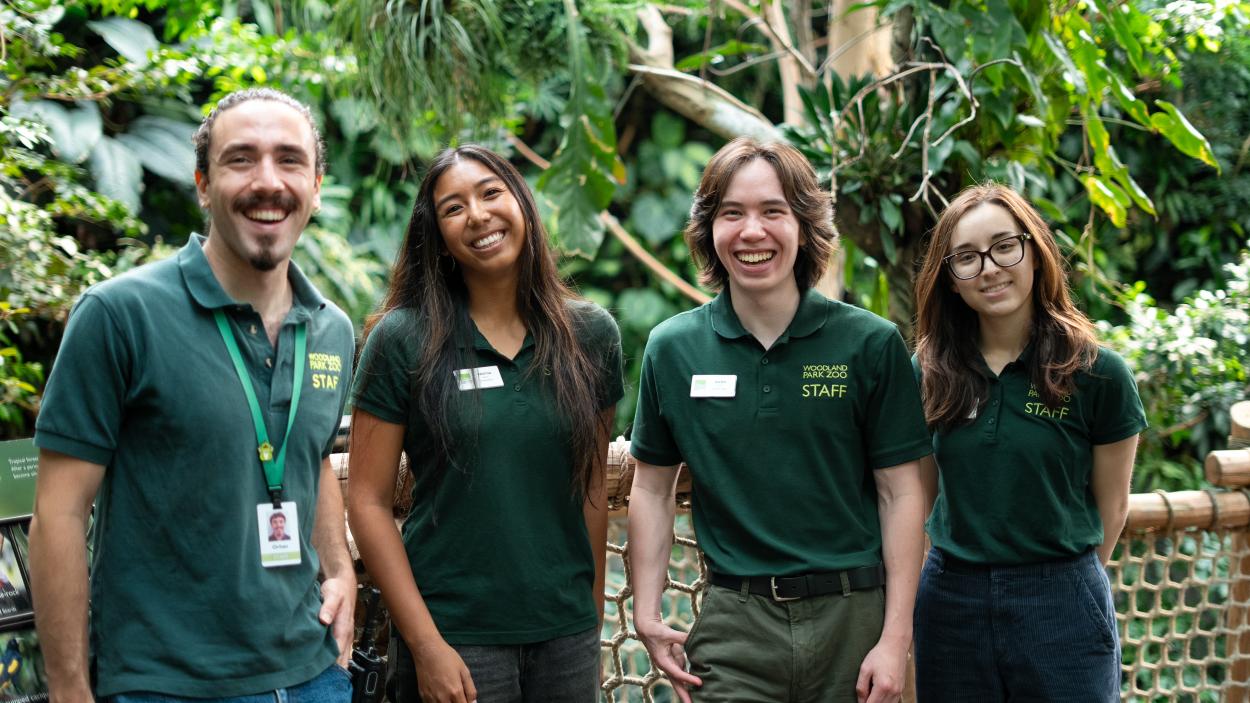
Animal keepers and support workers at Seattle’s Woodland Park Zoo ensure the animals stay safe and healthy, but they also face health and safety risks of their own. As the zoo’s first health and safety program manager, Orhan Eribac helps keep the keepers safe — from preventing run-ins with teeth, claws and beaks to everyday slips, trips and falls.

“Safety acts as a force multiplier for our mission of saving wildlife and inspiring everyone to make conservation a priority in their lives,” said Eribac, a recent MS alum of the UW Department of Environmental & Occupational Health Sciences (DEOHS). “By keeping our staff healthy and safe at work, they can provide better welfare and continuity of care for our animal friends, foster an enriching guest experience, and continue working at the cutting edge of animal care.”
This summer, Eribac welcomed DEOHS students Asher Maier and Casey Olmstead to join his team as interns. Meanwhile, another DEOHS student, Kristin Choe, interned on the zoo’s sustainability team.
All three boosted four-footed and two-footed well-being by going behind the scenes at the zoo, gaining invaluable insights into how occupational and environmental health intertwine at one of the city’s most beloved institutions.
“Worker health and the health and well-being of the animals are so connected,” said Maier, a health and safety intern who is a rising junior double majoring in environmental public health and computer science.
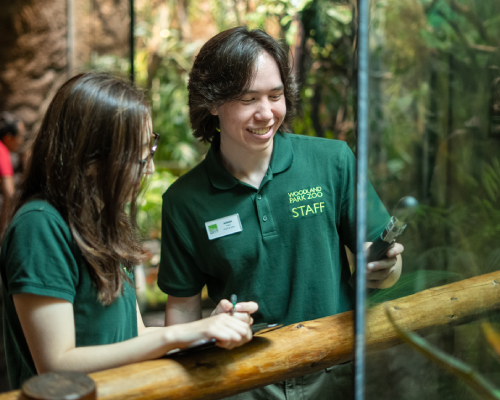
“If employees are experiencing injuries and can’t come to work, then the welfare of the animals is compromised. Or if there’s unintentional animal contact with humans, animals or people could be in danger.”
Going behind the scenes
Olmstead, a rising senior majoring in environmental public health, joined Maier on the health and safety team. Both Olmstead and Maier were inspired to intern at the zoo by taking a DEOHS class in One Health, a discipline that explores the health of humans, animals and the environments they share.
“I was very curious to see how that concept would be applied at the zoo, and more selfishly, I really wanted to see animals,” Olmstead said.
She got a chance to do both while spending time behind habitat spaces — feeding tree kangaroos and getting up close with curious bears. With Eribac, she and Maier observed the safety procedures animal keepers use when engaging with animals and their habitats.
They also consolidated the past five years of worker health and safety incident reports into a database. When they found that slips, trips and falls were some of the most common incidents reported, they created the foundations for a ladder and water safety training program for zoo employees, with input from staff at the Seattle Aquarium and workers at the zoo’s penguin habitat.
Working alongside wolves
For Maier, the most memorable experience involved watching keepers enter a habitat with the zoo’s four Mexican gray wolves.
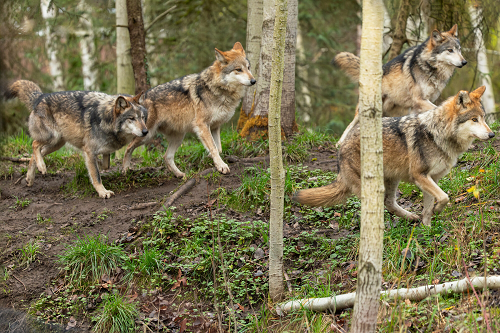
Under a species protection program that makes it possible for the wolves to be reintroduced into the wild, they must have limited contact with humans. That means they can’t be trained to enter their bedrooms when their habitat is serviced, like many of the zoo’s animals.
“From a workplace safety standpoint, I first thought, ‘Oh my god, you can’t be doing this,’” Maier said. But then he saw their personal protective equipment, specialized training, and Y-shaped poles with buffers to allow the keepers to gently push the wolves away if they came close.
“They were able do all their work while looking out for the wolves,” he said. “It was pretty incredible, talking with them about all the things they’re doing to keep themselves safe.”
Preventing disease spread
Both Olmstead and Maier also worked on projects to prevent the potential spread of zoonotic disease, or illnesses that can hop from humans to animals and vice-versa.
Olmstead designed a guide to help workers prevent and mitigate their disease risk, and Maier created a safety program defining how new animals are quarantined when joining the zoo.
Maier realized that zoo employees are required to go off site up to four times a year to be skin tested for tuberculosis, which can spread from animals to humans and vice-versa. After consulting with testing companies as well as his mom, who works in public health, he realized that offering zoo employees on-site blood tests would make screening more efficient and accurate.
After getting confirmation of his plan from Eribac and others, he connected with a clinic that will be providing on-site testing for zoo workers this fall.
“Having two DEOHS interns join me meant we could triple our impact,” Eribac said. “Asher’s and Casey’s professionalism, care and inventive thinking spoke volumes for the type of people they are and the high level of education and support students receive in UW DEOHS. I was constantly blown away at their ability to go above and beyond, challenge my thinking, and deeply empathize with workers.”
Supporting zoo-stainability
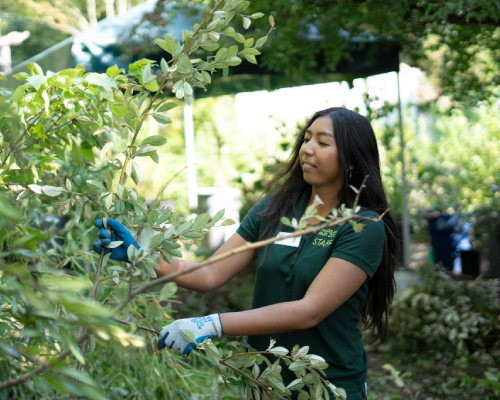
As an intern on the zoo’s sustainability team, Kristin Choe, a rising senior majoring in environmental public health, was all about the browse. That’s what zoo workers call plant trimmings collected from local gardens and parks to help supplement the animals’ diets.
Choe performed a cost-benefit analysis on the browse program, and found that the zoo is saving half a million dollars a year through these green donations from Seattle Parks and Recreation and Seattle Department of Transportation alone.
“They’re getting enough browse that it’s equivalent to 130 Space Needles stacked end to end,” Choe said.
Choe enjoyed going on ride-alongs with zoo employees to deliver browse and watch the animals enjoying it. She also worked on engagement with new partners interested in participating in the browse program, including Carnation Farms in Carnation, Washington.
In another project, she created a map of the zoo’s irrigation lines to improve sustainability in water usage.
“This internship has made me see how interconnected sustainability is to everything: human health, animal health, and the environment,” Choe said.