
On April 23, 2026, join the UW community for Husky Giving Day to raise funds that support UW students and programs. Your donation supports students like Adriana through the DEOHS Environmental Health Student Support Fund, which helps graduate students pay for research-related expenses, including travel and conference presentations to share their research.
For most people, dust is a nuisance, but for Adriana Riaño, it’s an archive. Riaño, a master’s student in the UW Department of Environmental & Occupational Health Sciences (DEOHS), is analyzing dust from people’s homes in the agricultural hub of Washington’s Yakima Valley to try to understand their exposure to pesticides.
“Dust can be a reservoir for many chemicals that accumulate — not only for farmworkers, but also for non-farmworkers,” she said. “I’m trying to look at which pesticides are highly accumulated, and what the potential health impacts of these exposures could be.”
Riaño’s dust samples were first collected by researchers more than 20 years ago — they come from a cohort of children and their families enrolled in a longitudinal study in the Yakima Valley led by Riaño’s adviser, DEOHS Professor Elaine Faustman. The team’s current project, Integrating and Informing Actionable Agricultural Community Tools (II-ACT), is continuing to glean new insights from these historic samples.
Pesticide exposure in homes near farms and orchards
Previously, the team found more than 47 pesticides in dust samples from the study, many of which are neurotoxic organophosphates. Riaño is now analyzing pyrethroids, which the U.S. Environmental Protection Agency recommended as a less toxic replacement when they phased out organophosphates in the early 2000s. Even so, there are neurological and other health concerns associated with these substitutes.
Riaño analyzed pyrethroids in dust samples from 2005 and 2011, and compared them with biomarkers called microRNAs in urine collected from adult study participants at the time. Next, she plans to explore whether these biomarkers are related to signs of neurodegenerative disease.
So far, Riaño has found that pyrethroid levels were similar in the house dust of both farmworkers and non-farmworkers throughout the year. During the pesticide-spraying season, levels of the pyrethroid compound permethrin were higher than during the non-spraying season in both sets of homes.
“Whether you work in agriculture or not, you could still be getting a certain amount of exposure” from house dust when you live in the lower Yakima Valley, she said. She is still examining the health concerns, if any, associated with that exposure.
“It’s important to characterize this chronic, low-dose exposure, which is really hard to define,” she said.
Sharing science in San Diego
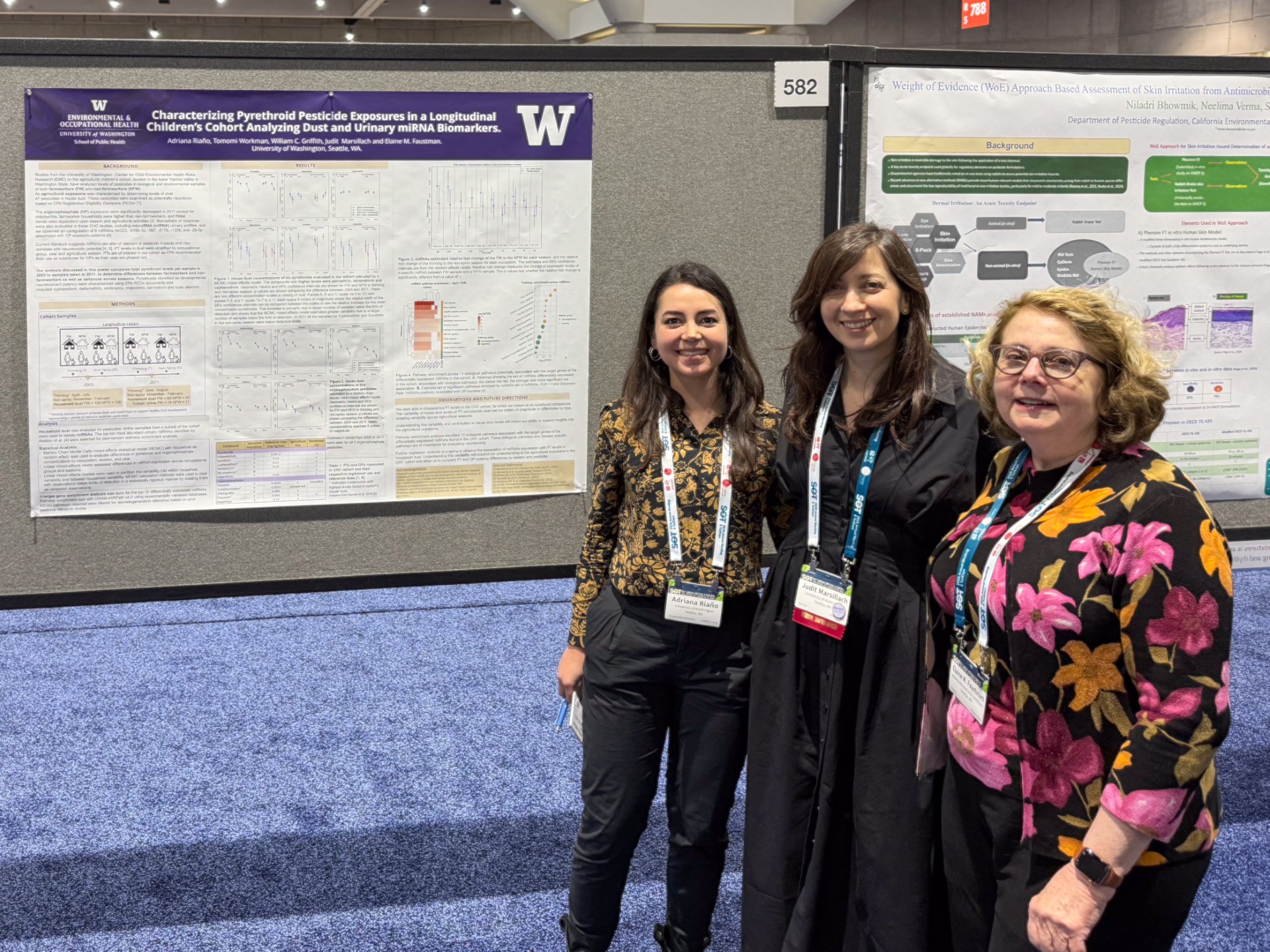
Riaño recently presented her research at the annual meeting of the Society of Toxicology in San Diego, which she attended with help from the DEOHS Environmental Health Student Support Fund. It was her first experience at a scientific conference.
“I was excited to learn what other people are working on so that I can continue growing in this field, and to network to see where my career can go,” she said.
In college, Riaño majored in environmental engineering with a focus on pollution. The work made her concerned about pollution’s health impacts, which prompted her to continue her studies in DEOHS.
“I decided to focus on environmental toxicology to try and understand what these chemical pollutants are doing, and what policy or regulations can help prevent exposures,” she said.
After she graduates this spring, she hopes to pursue a career that integrates her engineering background with public health.
“I would love to work at an intersection where both fields talk to each other,” she said.