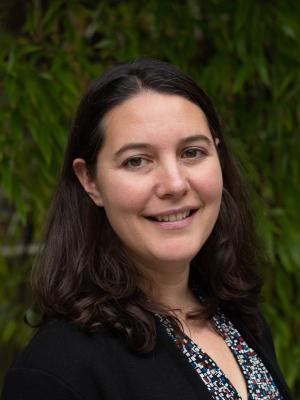
Elena Austin, Sc.D.
About
Dr. Austin received her Doctor of Science in environmental health from the Harvard T.H. Chan School of Public Health, with concentrations in exposure assessment and biostatistics. Her expertise areas and past work include multi-pollutant exposure metrics, geographic information systems, remote sensing, risk communication in farmworker communities, and the development and evaluation of data visualization tools. A number of her projects leverage novel applications of emerging technologies to improve worker health and safety, particularly in Washington state agricultural workers and their families.
In her ongoing work, Dr. Austin is advancing methods to assess combined exposures to multiple pollutants and implementing cutting-edge monitoring techniques. She leads intervention studies aimed at improving health outcomes in populations that have received limited attention in research, including children, outdoor workers and rural communities.
Education
- ScD, Harvard T.H. Chan School of Public Health
- MS, New York University
- BSc, McGill University
Mentorship
Available to mentor new Master's students in autumn 2027. Please follow the instructions on the How To Apply page.
DEOHS Students Mentored
PHIREWISE: Public Health Impact and Response on Wildfire Exposure and Health Support and Evaluation
Lilian Liu | PhD | 2026 | View
Beyond Expectations: Characterizing and Expanding the Roles of Community Health Workers in Environmental Health and the Built Environment
Pamela Lim | MS Thesis | 2025 | View
Understanding Firefighter’s Dermal PAH Exposure on Hands During Demobilization Based on Various Types of Gloves
Ikwon Jin | MS Thesis | 2024 | View
Glove Usability Report: Examining the Performance of Structural Fire Fighting Gloves, Leather Work Gloves, and a Leather and Medical Glove Combination Compared to Bare Hands
John Lykins | MS Applied | 2023 | View
Clean Air Equity: HEPA Air Purifier Efficacy and School Report-Backs
Alicia Kusaka | MS Applied | 2023 | View
Research
- Application of targeted environmental and occupational health strategies to improve population-level outcomes.
- Community-level exposure to ultrafine particles and related health concerns.
- Safe water use and well stewardship practices in rural agricultural areas.
- Health risks and workplace exposures among agricultural workers.
- Regional and international air pollution transport and its health impacts.
- Calibration and use of affordable environmental sensors in disaster response settings.
Publications
Selected publications
- Mapping Source-Specific Air Pollution Exposures Using Positive Matrix Factorization Applied to Multipollutant Mobile Monitoring in Seattle, WA
- Use of Portable Air Cleaners in Washington State Schools: A Qualitative Analysis Based on the Technology Acceptance Model
- Predictors of Dairy Worker Pre-Test and Post-Test Performance on a Dairy Safety Knowledge Test: Impact of Education Level and Native Language
- Wildfire Smoke Monitoring for Agricultural Safety and Health in Rural Washington
- Impacts of the COVID-19 responses on traffic-related air pollution in a Northwestern US city
Engagement
Equity, diversity and inclusion
I am passionate about engaging with diverse communities in my work. I work on several projects that have an explicit focus on equity and messaging to diverse communities. One project, entitled “Nitrate well water testing in agricultural communities: Improving environmental health communication with health behavior theory,” was developed based on needs identified through discussion with community groups and members in the Lower Yakima Valley. In Washington, for well connections with fewer than 15 individual homes and fewer than 25 people, the burden of testing and remediation rests on the well owner. The initial step for a well owner to identify a problem is to perform and interpret results of a water quality test. This testing must be repeated every six months using a certified lab. Previous work shows that well-water testing rates are low in this area, and the community expressed frustration at the lack of linguistically and culturally appropriate information materials. The outcomes of the project included clear identification of barriers to well-water testing and development of materials and workshop activities to promote access to clean water. I have also developed an active area of research in WA schools including Renton, Highline, Federal Way and Yakima School districts. These school districts are all highly impacted by environmental exposures and represent diverse student populations from underserved communities. By explicitly considering the impact of interventions on indoor air quality in these schools, my research goals are to provide actionable information to reduce impact of traffic, aircraft and wildfire smoke on children’s health.
As a young investigator, I am committed to diversity, inclusion and equity principles that guide my research as well as my interactions with students, colleagues, workers and communities. In research, I intend to accomplish this through community and stakeholder engagement, exposure assessments that include vulnerable communities, new partnerships and improved communication tools. In teaching, I am committed to highlighting important barriers, such as the lack of Spanish language information about many environmental and occupational exposures, and to challenging students and colleagues to devise and promote solutions. I believe that staff and students and all members of the department must feel included and valued to be engaged. As a mentor, I strive to create an environment where all feel empowered to share their experiences and ideas.
Community and research partnerships
I have several active research projects and service activities where community and research partnerships are integral components. These include relationship-building with the state Department of Health, Public Health – Seattle & King County and the Puget Sound Clean Air Agency on the topic of community exposures to aircraft emissions and public health intervention strategies. Throughout this process, I have maintained an ultrafine particle advisory group that has been meeting bi-yearly. In addition, I engage with fire departments in the region to measure the impact of occupational exposures in firefighters. I have also had significant engagement with dairy industry representatives and have led research projects involving the Washington State Dairy Federation, Oregon Dairymen’s Association and Oregon Dairy Farmers Association. This work has resulted in these organizations directly engaging in safety-related efforts, including training and safety-focused annual membership meetings.
Teaching practices
I teach ENV H 448/548: Community Air Pollution (Winter) and co-teach ENV H 564: Recognition of Health and Safety Problems in Industry (Autumn). Students learn how the burden of occupational and environmental exposures is unequally distributed, with Black, Hispanic and Indigenous communities consistently experiencing a higher burden of exposure, disease and lack of mitigation efforts. Open conversation, shared responsibility and thoughtful discussion are encouraged and fostered.
Service
- DEOHS curriculum committee member.
- DEOHS PhD exam committee member.
- Cascade Conference planning committee for wildfire smoke session (2022).
- Co-Director of the NIEHS Exposure Assessment, Biomarkers & Environmental Sensing Facility Core (NIEHS-funded EDGE Center).
- DEOHS student award committee (2022).
- Reviewer, SPH Dean’s Office scholarships and fellowships awards (2021-2022).
- Member, SPH Shared IT Services Task Force.
- International Society for Exposures Sciences: symposium organizer (2020).
- National Academy of Sciences Workshop organizer (2020-21): “Nitrogen losses in agriculture.”
- Planning committee for the airport community solutions summit (2021) working with community partners.
- Safety officer for the Rainier District Little League, handling COVID response and general league safety.